
The React example in examples/react-app is a development playground, not a hosted mockup. It requires a running API and a disposable key with read/write permission.
Create that application key in the dashboard. Keep the administrator credential out of the playground.
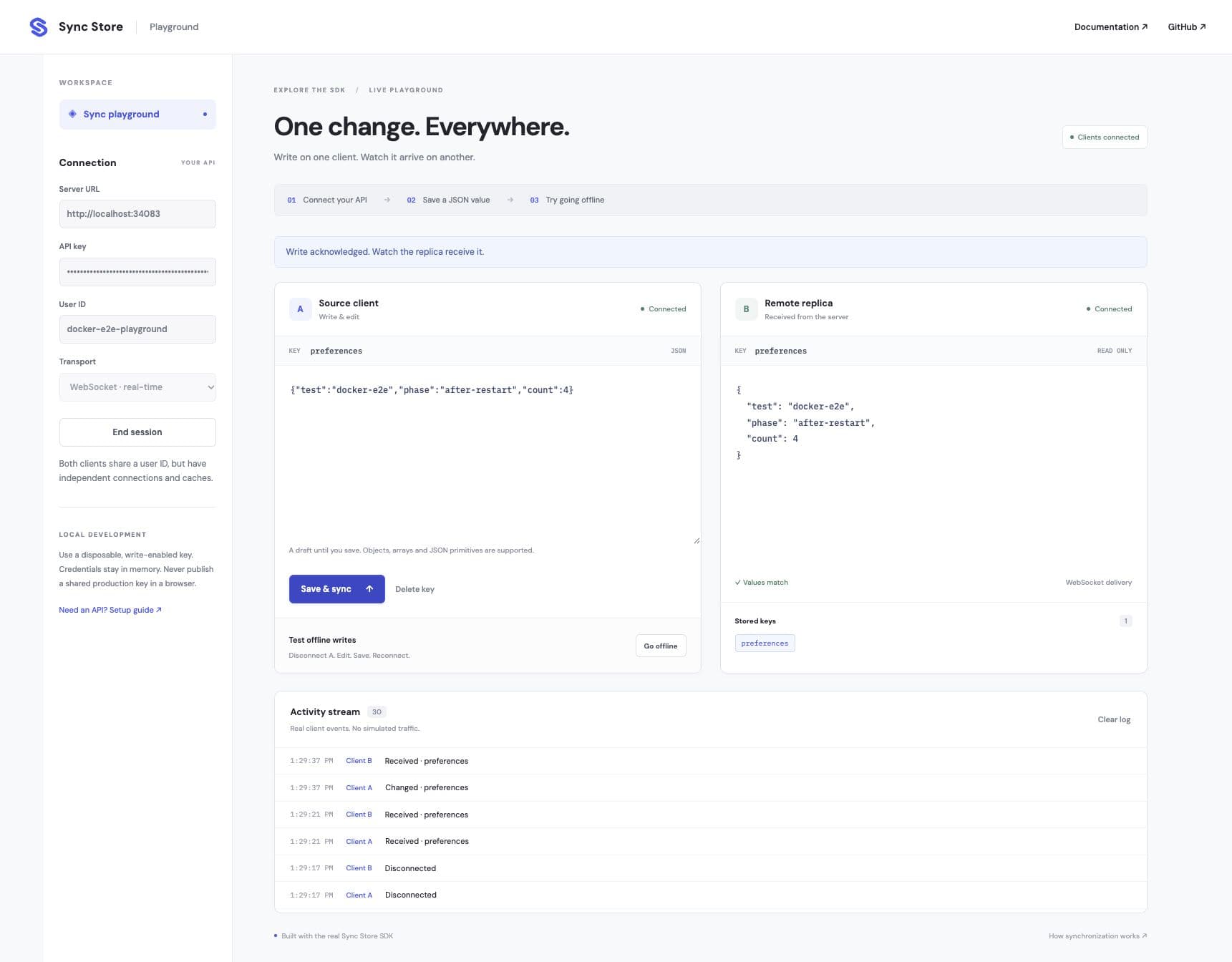
Two clients, one user
Client A and Client B use the same user ID and server, but different instance IDs and local cache namespaces. The replica receives its data through its own transport; the UI never copies A's state into B.
- Enter your server origin, API key and user ID.
- Choose WebSocket for realtime events or HTTP for polling.
- Select Connect clients. Both connections must succeed.
- Edit the JSON draft and select Save & sync.
- Observe the value in Remote replica and the real client events in Activity stream.
The initial preferences JSON is an unsaved draft. The playground never creates data until you explicitly save. Try false, 0, "" and null as well as objects and arrays. Invalid JSON is rejected before a write.
Disconnect and recover
Select Go offline on Client A. This disconnects A's transport; it does not turn off the computer's network or disconnect B.
Edit the draft and select Save locally. B should keep its previous value until A reconnects. Select Reconnect: A flushes its outbox and reconciles with the server; B receives the update.
Delete key only removes the selected key. Deletions made offline remain queued. Clear log clears the UI event log, not stored data.
Sessions and privacy
Credentials live in React memory and are not stored in localStorage or sessionStorage. The SDK's cache and outbox do contain your JSON values in browser storage. Do not use confidential data on a shared computer.
Each tab stores a nonsecret session ID in sessionStorage. Ending a session destroys its connections, but preserves pending outbox entries. Reconnect using the same server, user and tab to recover pending writes. Do not clear browser storage before delivery.
The log holds the last 30 observed events and deliberately excludes credentials and JSON payloads. It is not a durable audit log.
Run and customize
bun run --cwd packages/sync-client build
bun run --cwd examples/react-app dev
bun run --cwd examples/react-app test:types
bun run --cwd examples/react-app build
Set VITE_DOCS_URL to the deployed documentation URL ending in /docs to change the help links. The default is http://localhost:4000/docs.
For a smaller example without React or the SDK, serve examples/basic-usage/index.html from the repository. It uses direct REST calls and does not implement realtime subscriptions or an offline queue.